Use a computer for linear operations (e.g. matrix multiplication, matrix vector etc), provided you know how to do it manually.
What you are bound to do:
Write down the solutions yourself, while being alone.
What you are not allowed to do:
Copy the written solutions from a classmate.
Use AI to output the solutions.
Problems
Exercise 1 Karl has a boring life. He either spends one hour on instagram, or one hour on TikTok, or watches Youtube videos about Markov Chains for 5 minutes, or sleeps for 25 minutes.
When he wakes up, he always checks Instagram first.
When finishing checking Instagram, he either watches Youtube videos about Markov Chains, or checks TikTok with equal probability.
When he is done with Youtube, he always sleeps since Markov Chains are boring.
When he is done with TikTok, he will either check Instagram or go to sleep with equal probability.
Represent Karl’s life as a Markov Chain, with a transition probability matrix (stochastic matrix) and with a weighted graph.
Right now, Karl is on Instagram. Find the probability that the tenth app he will open on his phone will be Instagram. E.g. when considering the transitions I-> Y -> S -> I, the second app he opens is Instagram.
After many years of such a fascinating life, what percentage of his lifetime will he have spent on Instagram?
TipSolution
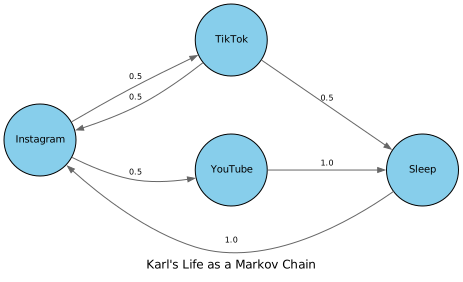
The transition probability operator \(P\) is (1: Instagram, 2: TikTok, 3: YouTube, 4: Sleep) \[ P = \begin{pmatrix} 0 & 1/2 & 1/2 & 0 \\ 1/2 & 0 & 0 & 1/2 \\ 0 & 0 & 0 & 1 \\ 1 & 0 & 0 & 0 \end{pmatrix} \] and here the associated graph.
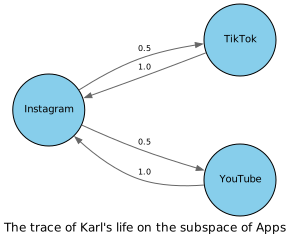
Figure 1: Karl’s life and the trace on the subspace of apps. Every second app he uses is Instagram.
Every second app he opens is Instagram, so this probability is \(1\).
Let’s call \(\mathcal{N}_x\) the number of times Karl visits the state \(x\) after many years, say after \(N\) steps. We understand that the problem asks for the limit \(N\to \infty\).
Let \(\gamma_x=\mathbb{E}_x[\mathcal{N}_x]/N\) the expected number times he has been in the state \(x\). Then
The expected number of times he visits YouTube is half the number of times he visits Instagram up to a small (random) error: \(\gamma_Y= \gamma_I/2+\varepsilon_{Y}\).
The expected number of times he visits TikTok is also half the number of times he visits Instagram up to a small random error: \(\gamma_T= \gamma_I/2+\varepsilon_{T}\).
To solve one should not forget: \(\gamma_I+\gamma_Y+\gamma_T+\gamma_S=1\).
Here what we mean is that \(\varepsilon_{x}\) is some small error \(O(1/N)\), which is due to the fact that Karl starts in a specific state (Instagram). So for instance for \(N=1\), we have \(\gamma_I=1\), all the others being \(0\). So we get \(\gamma_I=4/11+O(1/N)\), \(\gamma_Y=2/11+O(1/N)\), \(\gamma_T=2/11+O(1/N)\), \(\gamma_S=3/11+O(1/N)\). The fraction of time he spends on Instagram will then be \[ \begin{aligned} \frac{\gamma_I *60+O(1/N)}{ \gamma_I*60+\gamma_Y*5+\gamma_T*60+\gamma_S*25+O(1/N)}\simeq 0.5393+O(1/N) \end{aligned} \tag{1}\] So after many years (\(N\to\infty\)) he will have spent around 54% of his boring life on Instagram.
As a more robust alternative, we can consider \[ \lim_{T\to \infty} \frac{1}{T}\sum_{t=0}^{T-1} f(X_t)=m(f) \] where \(m\) is the invariant measure of the process. Actually \(m_x\) is nothing but the leading term of the aforementioned \(\gamma_x\), namely \(m_I=4/11\), \(m_Y=m_T=2/11\), \(m_S=3/11\). Now we take \(f(x)\) as the amount of time he spends each time on the state \(x\) (e.g. \(f(I)=60\) minutes etc), and \(g(x)=f(x) \mathbf{1}_{x=I}\). Then we get \[ \lim_{T\to \infty} \frac{\sum_{t=0}^{T-1} g(X_t)}{\sum_{t=0}^{T-1} f(X_t)}=\frac{m(g)}{m(f)} \simeq 0.5393 \]
Exercise 2 Anna has just received \(m\) bikes for her birthday. Each day now, she will pick one bike randomly (each one with probability \(1/m\)) and return home in the evening. Let \(X_t\) be the number of different bikes she will have used after \(t\) days (so \(X_0=0\), \(X_1=1\), but \(X_2\) may be \(1\) or \(2\) and so on).
Explain why \((X_t)\) is a Markov chain.
Let \(\tau_m\) be the random time at which she will have tried all the bikes. Is this a stopping time?
Find the probability \(\mathbb{P}(\tau_m=t)\), recalling that \(X_0=0\).
TipSolution
The probability that on a given day she will use a never-used bike only depends on how many bikes has she already used, and not on which or which order she used them. So this is a Markov chain with state space \(S=\{0,\ldots,m\}\), and \(p_{x,x}=x/m=1-p_{x,x+1}\) (of course \(p_{m,m}=1\) so \(p_{m,m+1}\) is just not defined). Each singleton of the state space is a communicating class, with \(\{m\}\) being the only closed one.
This is a stopping time. Actually it is the hitting time of \(\{m\}\).
We have \(\mathbb{P}_x(\tau_m=t)=\mathbb{P}_x(X_{t-1}=m-1,X_t=m)=p^{(t-1)}_{x,m-1}p_{m-1,m}\). \(p_{m-1,m}=1/m\) so we just need to compute the power \(p^{(t-1)}_{0,m-1}\). The matrix \(P\) has eigenvalues \(\{0,1/m,2/m,\ldots,1-1/m,1\}\). They are all real and simple, and let us call \(\lambda_x=x/m\). The fact that \(\lambda_x=x/m\) corresponds to the following remark1: once Anna has used exactly \(x\) bikes (e.g. if the chain starts in the state \(x\)), she will not use a never-used bike for \(t\) more days with probability \(\lambda_x^t\). The corresponding left eigenvectors \(f^x P =\lambda_x f^x\), and right eigenvectors \(P e^x=\lambda_x e^x\) are \[ \begin{aligned} & (e^x)_y= \binom{m-y}{x-y} \mathbf{1}_{y\le x} \\ & (f^x)_y=(-1)^y \binom{m-x}{y-x} \mathbf{1}_{y\ge x} \end{aligned} \] Thus by linear algebra \[ (p^{(t)})_{x,y} = \sum_{z=0}^{m} \frac{(e^z)_x \, \lambda_z^t \, (f^z)_y}{e^z \cdot f^z} = \sum_{z=x}^y (-1)^{y-z} \binom{m-x}{z-x,y-z,m-y} \left(\frac{z}{m}\right)^t \] In particular \[ \mathbb{P}(\tau_m=t)=p^{(t)}_{0,m-1}/m = \sum_{z=0}^{m-1} (-1)^{m-z+1} \binom{m-1}{z} \left(\frac{z}{m}\right)^{t-1} \tag{2}\] An alternative method involves the inclusion-exclusion principle. Let \(A_i\) be the event that bike \(i\) has not been used by day \(t\). Let’s first compute \[ \mathbb{P}(X_t=m) = 1 - \mathbb{P}\left(\cup_{i=1}^m A_i\right) \] By the principle of inclusion-exclusion: \[ \mathbb{P}\left(\bigcup_{i=1}^m A_i\right) = \sum_i \mathbb{P}(A_i) - \sum_{i<j} \mathbb{P}(A_i \cap A_j) + \cdots + (-1)^{m+1} \mathbb{P}(A_1 \cap \cdots \cap A_m) \] The probability of not picking a specific set of \(k\) bikes in \(t\) days is: \(\mathbb{P}(A_{i_1} \cap \cdots \cap A_{i_k}) = (\tfrac{m-k}{m})^t\) There are \(\binom{m}{k}\) ways to choose which \(k\) bikes to exclude. Plugging this into the inclusion-exclusion formula gives \[ \mathbb{P}(\tau_m=t)=\mathbb{P}(X_t=m)-\mathbb{P}(X_{t-1}=m) = \sum_{k=1}^m (-1)^{k} \binom{m}{k}\left((\tfrac{m-k}{m})^t-(\tfrac{m-k}{m})^{t-1}\right) \] which gives the same answer as Equation 2.
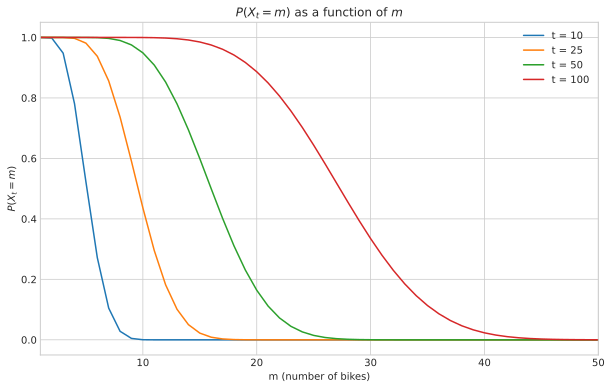
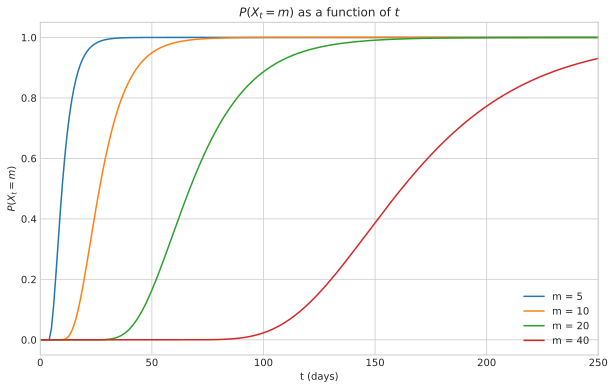
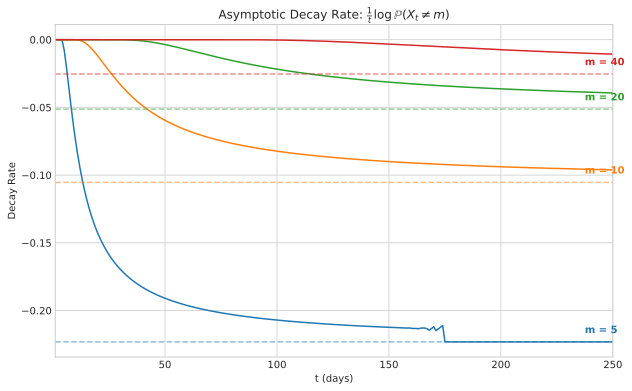
Figure 2: The plots show the \(\mathbb{P}(X_t=m)\) as a function of \(m\) for fixed \(t\), and more interestingly as a function of \(t\) for fixed \(m\). For \(t\) large, \(\mathbb{P}(X_t \neq m)\simeq (\lambda_{m-1})^t \simeq e^{-t/m}\). We see this fact by computing \(\tfrac{1}{t}\log \mathbb{P}(X_t\neq m)\). For \(t\) large, it converges to its asymptote \(\log(1-1/m)\). For \(m\) small, the convergence to \(0\) is faster: when the probability is thus very small, we see a machine-error issue (the weird behavior in the blue plot), a reminder of the challenging problem of computing exponents numerically.
Exercise 3 In a tennis game, two players A and B play points. Player A wins a point with probability \(p\) and player B wins a point with probability \(1-p\). The game ends when one of the players has won \(4\) points in total and at least 2 points more than the opponent.
Model the game as a Markov chain on a finite state space, and represent it as a weighted graph.
Is this an irreducible Markov chain? If not, determine the communicating classes and the closed ones.
What is the probability that the game lasts no more than \(5\) points?
What is the probability that player A wins the game?
Suppose now that player A has a psychological advantage, and if the point decides the game (namely the point may end the game), A wins it with probability \(q > p\).
What is the probability that player A wins the game now?
(Optional) Run a computer simulation to estimate the results of a. and b. numerically for a fixed value of \(p\). Compare the results with the theoretical ones.
TipSolution
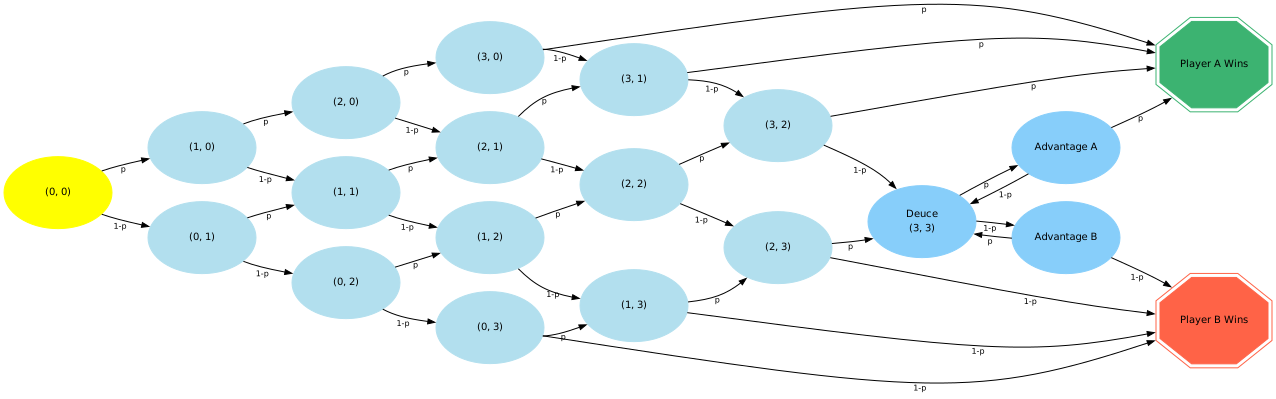
While in principle the points count can grow indefinitely, we can make it a finite-state chain by counting only the advantage of the players once both reached \(3\) points. This is exactly how they count points officially in tennis games, and it can be easily represented by the following directed graph.
Figure 3
Each state where at least one of the two players has no more than \(2\) points is a communicating class as a singleton. Indeed, this score can never be reached again. Each of the two states where one player wins, is a closed communicating class. Finally the three states, Deuce, Advantage A and Advantage B are all together a communicating class (not a closed one though).
The game lasts not more than 5 points if it ends in exactly \(4\) or \(5\) points.
The game ends in \(4\) points with probability \(p^4 + (1-p)^4\) (probability of the trajectory where A always wins, plus the one where B always wins).
The game ends in \(5\) points exactly on the following trajectories: A wins \(3\) of the first \(4\) points, then wins the last one; or B wins \(3\) of the first \(4\) points, then wins the last one. The probability in this case is \(\binom{4}{1} p^4(1-p) +\binom{4}{1} p(1-p)^4\).
The required probability is then \(p^4 + (1-p)^4 + 4p^4(1-p) + 4p(1-p)^4\).
Let \(a,b\) be the states where A wins and B wins respectively, \(i\) the initial state with score \((0,0)\), and \(d\) the state Deuce. We use the notation introduced in the notes: \(h_x(y)\) is the probability of hitting the state \(x\) when starting in \(y\), and \(h_{x,y}(z)\) is the probability of hitting \(x\) before \(y\) when starting in \(z\). Since \(\mathbb{P}(\tau_{\{a,b\}}<\infty)=1\), in principle we can just define \(h_a(x)\) as the probability that A wins when the score is \(x\), solve the linear problem for hitting probabilities and find the required \(h_a(i)\).
The state space here is quite large however, so let’s compute this probability less systematically. The event that player A wins the game is the union of all the possible trajectories ending in \(a\). There are two types of trajectories: those where B never reaches 3 points (so that Deuce is not hit) and those reaching Deuce.
The probability of winning without ever reaching Deuce is the sum of the probabilities of all those trajectories: \(h_{a,d}(i)=p^4+ \binom{4}{1} p^4(1-p)+ \binom{5}{3} p^4 (1-p)^2\) (there is one trajectory where A wins all points, \(\binom{4}{1}\) where B wins \(1\) point and A wins \(4\) points including the last one, \(\binom{5}{2}\) where B wins \(2\) points and \(A\) wins \(4\) points including the last one).
The probability of reaching Deuce is \(h_d(i) = \binom{6}{3} p^3 (1-p)^3\).
Once we are in Deuce, we can forget about the rest and solve the harmonic problem from this point on: if A wins the next two points (probability \(p^2\)), A wins the game. If B wins the next two points (probability \((1-p)^2\)), B wins the game. If they each win one point (probability \(2p(1-p)\)), the score returns to deuce. We can write a recursive equation \(h_a(d)\): \[ h_a(d)= p^2+2p(1-p) h_a(d) \] or \(h_a(d)=\frac{p^2}{p^2 + (1-p)^2}\).
The probability of hitting Deuce and winning is then \(h_a(d) h_d(i)\) (by the strong Markov property).
Therefore the probability that A wins is \[ h_a(i)=h_{a,d}(i)+h_a(d) h_d(i)= p^4(1 + 4(1-p) + 10(1-p)^2) + 20 p^3(1-p)^3 \frac{p^2}{p^2 + (1-p)^2} \]
This works with the same approach as before, but hopefully the solution cannot be found online! Let’s calculate the probability of A winning under this new condition.
The probability of winning without ever reaching Deuce is \(h_{a,d}(i)=[p^3]q + [p^3(1-q) + \binom{3}{1} p^3(1-p)]q+[p^3(1-q)^2 + \binom{3}{1} p^3(1-p)(1-q) + \binom{4}{2}p^3(1-p)^2]q\), where the square bracketed terms, multiplied by \(q\), correspond to the probabilities of winning in \(4\), \(5\) and \(6\) points respectively.
The probability of reaching Deuce can be computed as \[ \begin{aligned} h_d(i) & = (1-q) h_{(3,2)}(i) + q h_{(2,3)} = (1-q)\left[p^3(1-q)^2 + \binom{3}{1} p^3(1-p)(1-q) + \binom{4}{2}p^3(1-p)^2\right] \\ & \qquad + q \left[(1-p)^3q^2 + \binom{3}{1} (1-p)^3p q + \binom{4}{2}(1-p)^3p^2 \right] \end{aligned} \]
The probability of winning from the Deuce state solves \[ h_a(d)= p(q+(1-q)h_a(d))+(1-p)(q h_a(d)) \] or \(h_a(d)=(p q)/(1-p-q+2p q)\).
The probability of winning is ultimately \[ h_a(i)= h_{a,d}(i)+h_a(d)*h_d(i)= \tfrac{p q \left(-9 p^4 (q-1)-p^3 \left(q^2-24 q+23\right)+p^2 \left(2 q^3-2 q^2-15 q+15\right)-3 p (q-1) q^2+q^3\right)}{p (2 q-1)-q+1} \]
This can be more easily solved just using a linear solver (the harmonic equation), which gives the same solution
Click to view the code
import sympy as sp# Declare sympy symbolsp, q, h_d, h_a, h_b = sp.symbols('p q h_d h_a h_b')# Solve the deuce sub-problem in-line to get the win probability from deuce.h_deuce = sp.solve([ sp.Eq(h_d, p*h_a + (1-p)*h_b), sp.Eq(h_a, q + (1-q)*h_d), sp.Eq(h_b, q*h_d)], (h_d, h_a, h_b))[h_d]# Define a recursive solver for the probability from any score (a,b).def prob(a, b):if a >=4and a >= b +2: return1if b >=4and b >= a +2: return0if a ==3and b ==3: return h_deuce# Use 'q' on game points, otherwise 'p'. pt_prob = q if (a ==3and b <3) or (b ==3and a <3) else preturn pt_prob * prob(a +1, b) + (1- pt_prob) * prob(a, b +1)# Print the result from the initial score (0,0)result = sp.simplify(prob(0, 0))print(f"""--- Probability of Player A Winning a Game ---[ LaTeX format ]{sp.latex(result)}[ Mathematica format ]{sp.mathematica_code(result)}[ Plain text format ]{result}""")
--- Probability of Player A Winning a Game ---

[ LaTeX format ]
\frac{p q \left(- 9 p^{4} q + 9 p^{4} - p^{3} q^{2} + 24 p^{3} q - 23 p^{3} + 2 p^{2} q^{3} - 2 p^{2} q^{2} - 15 p^{2} q + 15 p^{2} - 3 p q^{3} + 3 p q^{2} + q^{3}\right)}{2 p q - p - q + 1}

[ Mathematica format ]
p*q*(-9*p^4*q + 9*p^4 - p^3*q^2 + 24*p^3*q - 23*p^3 + 2*p^2*q^3 - 2*p^2*q^2 - 15*p^2*q + 15*p^2 - 3*p*q^3 + 3*p*q^2 + q^3)/(2*p*q - p - q + 1)

[ Plain text format ]
p*q*(-9*p**4*q + 9*p**4 - p**3*q**2 + 24*p**3*q - 23*p**3 + 2*p**2*q**3 - 2*p**2*q**2 - 15*p**2*q + 15*p**2 - 3*p*q**3 + 3*p*q**2 + q**3)/(2*p*q - p - q + 1)
Here the comparison. Feel free to resize the box and edit the code.
#| '!! shinylive warning !!': |
#|   shinylive does not work in self-contained HTML documents.
#|   Please set `embed-resources: false` in your metadata.
#| standalone: true
#| components: [viewer, editor]
#| viewerHeight: 970
#| editorHeight: 120
#| layout: vertical
#| id: tennis

from shiny import App, render, ui, reactive, req
import matplotlib.pyplot as plt
import random
import theme

# ========= 1. UI DEFINITION =========
app_ui = theme.layout(
    ui.sidebar(
        ui.h4("Simulation Controls"),
        ui.input_slider(
            "p",
            "Player A's point win probability (p):",
            min=0.0, max=1.0, value=0.6, step=0.01
        ),
        ui.input_slider(
            "N",
            "Number of Games to Simulate (N):",
            min=100, max=20000, value=1000, step=100
        ),
        ui.input_action_button("run_simulation", "Run Simulation", class_="btn-success"),
        title="Tennis Game Simulation",
    ),

    ui.output_ui("results_display"),
    ui.output_plot("game_length_plot", height="500px"),
    title="Tennis Game Markov Chain Simulation",
)

# ========= 2. SERVER LOGIC =========
def server(input, output, session):
    theme.setup_plot_style()
    # This reactive value holds the simulation results.
    simulation_results = reactive.Value(None)

    def simulate_one_game(p):
        """Simulates a single game of tennis and returns the winner and duration."""
        score_a, score_b = 0, 0
        points_played = 0
        while True:
            points_played += 1
            if random.random() < p:
                score_a += 1
            else:
                score_b += 1

            # Check for win condition
            if score_a >= 4 and score_a >= score_b + 2:
                return 'A', points_played
            if score_b >= 4 and score_b >= score_a + 2:
                return 'B', points_played

    def calculate_theoretical_probs(p):
        """Calculates the theoretical probabilities based on the solution formulas."""
        # Probability the game lasts not more than 5 points
        prob_le_5_points = (p**4 + (1-p)**4) + (4 * p**4 * (1-p) + 4 * p * (1-p)**4)

        # Probability Player A wins
        prob_a_wins_no_deuce = p**4 + 4 * p**4 * (1-p) + 10 * p**4 * (1-p)**2
        prob_deuce = 20 * (p**3) * ((1-p)**3)
        prob_a_wins_from_deuce = (p**2) / (p**2 + (1-p)**2) if (p**2 + (1-p)**2) > 0 else 0
        prob_a_wins_total = prob_a_wins_no_deuce + prob_deuce * prob_a_wins_from_deuce

        return {
            "prob_a_wins": prob_a_wins_total,
            "prob_le_5_points": prob_le_5_points
        }

    @reactive.Effect
    @reactive.event(input.run_simulation, ignore_init=True)
    def _():
        """This function runs ONLY when the run_simulation button is clicked."""
        p = input.p()
        N = input.N()

        wins_a = 0
        short_games = 0
        game_lengths = []

        for _ in range(N):
            winner, length = simulate_one_game(p)
            if winner == 'A':
                wins_a += 1
            if length <= 5:
                short_games += 1
            game_lengths.append(length)

        sim_prob_a_wins = wins_a / N
        sim_prob_le_5 = short_games / N

        theoretical = calculate_theoretical_probs(p)

        simulation_results.set({
            "sim_prob_a_wins": sim_prob_a_wins,
            "sim_prob_le_5": sim_prob_le_5,
            "theo_prob_a_wins": theoretical["prob_a_wins"],
            "theo_prob_le_5": theoretical["prob_le_5_points"],
            "game_lengths": game_lengths,
            "N": N
        })

    @output
    @render.ui
    def results_display():
        results = simulation_results.get()
        if not results:
            return ui.p("Click 'Run Simulation' to see the results.", class_="text-center")

        return ui.div(
            ui.h4("Comparison of Results"),
            ui.div(
                ui.div(
                    ui.h5("Probability A Wins"),
                    ui.p(f"Theoretical: {results['theo_prob_a_wins']:.4f}"),
                    ui.p(f"Simulated: {results['sim_prob_a_wins']:.4f}"),
                    class_="card-body"
                ),
                class_="card bg-light mb-3"
            ),
            ui.div(
                ui.div(
                    ui.h5("Probability Game Lasts ≤ 5 Points"),
                    ui.p(f"Theoretical: {results['theo_prob_le_5']:.4f}"),
                    ui.p(f"Simulated: {results['sim_prob_le_5']:.4f}"),
                    class_="card-body"
                ),
                class_="card bg-light mb-3"
            ),
        )

    @output
    @render.plot
    def game_length_plot():
        results = simulation_results.get()
        req(results)

        game_lengths = results["game_lengths"]
        N = results["N"]

        fig, ax = plt.subplots(figsize=(8.5, 6))

        # Calculate discrete bins for the histogram
        max_len = 0
        if game_lengths:
            max_len = max(game_lengths)
            # Create bin edges like [3.5, 4.5, 5.5, ...]
            bins = [i + 0.5 for i in range(3, max_len + 2)]
        else:
            bins = [i + 0.5 for i in range(3, 10)]

        ax.hist(game_lengths, bins=bins, rwidth=0.8, align='mid', color='royalblue', alpha=0.7)
        # Set x-axis ticks using a standard range
        ax.set_xticks(range(4, (max_len if game_lengths else 9) + 2))
        ax.set_xlabel("Total Points in Game", fontsize=12)
        ax.set_ylabel("Frequency", fontsize=12)
        ax.set_title(f"Distribution of Game Lengths over {N} Simulations", fontsize=14)
        ax.grid(True, linestyle='--', alpha=0.5)

        return fig

# ========= 3. APP INSTANTIATION =========
app = App(app_ui, server)


## file: theme.py
from shiny import ui
import matplotlib.pyplot as plt

def layout(sidebar, *args, **kwargs):
    """
    Standard layout wrapper for all Shinylive apps.

    Args:
        sidebar: A ui.sidebar() object.
        *args: Main content elements.
        **kwargs: Additional arguments for ui.page_sidebar (e.g., title, fillable).
    """
    return ui.page_sidebar(
        sidebar,
        # Standard CSS across all apps
        ui.tags.style("""
            :root {
                --bs-body-font-family: "Inter", sans-serif;
                --bs-font-monospace: "Source Code Pro", monospace;
            }
            body {
                font-family: var(--bs-body-font-family) !important;
            }
            .bslib-sidebar-layout .sidebar-content {
                font-size: 14px;
            }
            /* Ensure plots blend in if needed */
            .shiny-plot-output {
                background-color: transparent;
            }
        """),
        *args,
        **kwargs
    )

def setup_plot_style():
    """
    Configures Matplotlib to match the web theme (Source Sans 3).
    """
    # Attempt to use Inter if available, else fallback to sans-serif
    plt.rcParams.update({
        "font.family": "sans-serif",
        "font.sans-serif": ["Inter", "Source Sans 3", "DejaVu Sans", "sans-serif"],
        "axes.titlesize": 13,
        "axes.labelsize": 11,
        "xtick.labelsize": 10,
        "ytick.labelsize": 10,
        "figure.figsize": (8, 5),
        "axes.grid": True,
        "grid.alpha": 0.3,
        "grid.linestyle": ":",
        # Transparent backgrounds to match web theme
        "figure.facecolor": "none",
        "axes.facecolor": "none",
        "savefig.facecolor": "none"
    })
Exercise 4 We want to give an analytical characterization of the transition probabilities \(q_{x,y}\) of the trace of a recurrent Markov chain. We proved that the trace of \(\mathbf{X}\) on \(A\) has transition probabilities, for \(x,y\in A\)\[ q_{x,y}=\mathbb{P}_x(X_{\tau^+_A}=y) \] Define the operator \(P^{(A^c)}\) with entries \[ p^{(A^c)}_{x,y}= \begin{cases} p_{x,y} & \text{if $y\notin A$} \\ 0 & \text{if $y\in A$} \end{cases} \] Prove that, for each fixed \(y\in A\), \(q_{x,y}\) is the minimal solution to the problem in the unknown \(h \ge 0\)\[ ((I-P^{(A^c)}) h)(x) = p_{x,y}, \qquad x\in S \tag{3}\] meaning \(q_{x,y} - \sum_{z \notin A} p_{x,z} q_{z,y} = p_{x,y}\) for all \(x\in S\).
TipSolution
Fix \(y \in A\), and denote \(h(x) \equiv q_{x,y}= \mathbb{P}_x(X_{\tau_A^+} = y)\) for \(x\in S\). By conditioning on the first step: \[ h(x) = \sum_{z \in S} p_{x,z} \mathbb{P}_x(X_{\tau_A^+}=y | X_1=z) = \sum_{z\in A} p_{x,z} \mathbf{1}_{y=z}+\sum_{z\notin A} p_{x,z} h(z)= p_{x,y}+\sum_{z\notin A} p_{x,z} h(z) \] To prove minimality, let now \(g \ge 0\) be any non-negative solution to the system Equation 3 for a fixed \(y\in A\) (which we omit from the notation). Define \(h^{(n)}(x):= \mathbb{P}_x(X_{\tau_A^+} = y, \tau_A^+\le n)\). Then \(h^{(n)}(x) \le q_{x,y}\), and by the continuity of probabilities on monotone sequences, \(h^{(n)}(x) \uparrow h(x)\). Therefore it is enough to check that \(g\ge h^{(n)}\) for all \(n\ge 0\). Now we proceed by induction.
Trivially \(g\ge h^{(0)}\equiv 0\).
\(h^{(n)}\) satisfies (reasoning as for \(q_{\cdot,y}\) above) \[ h^{(n+1)}(x)=p_{x,y}+\sum_{z\notin A} p_{x,z} h^{(n)}(z) \] Therefore by the induction hypothesis \[ g(x)= p_{x,y}+(P^{(A^c)}g)(x) \ge p_{x,y}+(P^{(A^c)}h^{(n)})(x) = h^{(n+1)}(x) \]
Footnotes
One may check that if \(p^{(t)}_{x,x}=\lambda^t\) for some \(x\in S\), \(\lambda \in [0,1]\) and all\(t\in \mathbb{N}\), then \(\lambda\) is an eigenvalue of \(P\).↩︎