Midterm Classwork: Examples
Exercises
Exercise 1 I have \(3\) umbrellas, and each of them may be at home or at the office. Each time I go from home to office, or from the office to home, I take an umbrella with me iff it rains. However, if there are no umbrellas available and it rains, I get wet. The probability that it rains during a given trip office/home or home/office is \(p\). Find the probability that I get wet on a given trip.
The time \(t\) here represents the number of places (office/home) visited. We let \(X_t\) be the number of umbrellas that are in the place where I am. This is a Markov chain with state space \(S=\{0,1,2,3\}\). If \(x=0\), then \(p_{0,3}=1\), since once I change place, all the umbrellas will be at the new place. \(p_{1,3}=p\) (since I will bring with me the only available umbrella iff it rains), \(p_{1,2}=1-p\); and similarly \(p_{2,2}=p=1-p_{2,1}\); finally \(p_{3,1}=p=1-p_{3,0}\). In other words, for \(x\ge 1\), \(p_{x,y}=p\) if \(y=4-x\) (since I will bring the umbrella with me), and \(p_{x,y}=1-p\) if \(y=3-x\).
The transition probabilities matrix is then \[ P = \begin{pmatrix} 0 & 0 & 0 & 1 \\ 0 & 0 & 1-p & p \\ 0 & 1-p & p & 0 \\ 1-p & p & 0 & 0 \end{pmatrix} \]
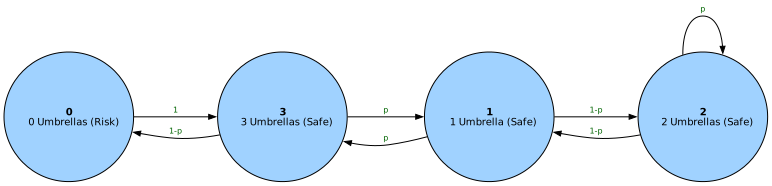
This is an irreducible Markov chain, with unique invariant probability. It is easy to see that \(m_3=m_2=m_1\). So using \(mP=m\) we get \(m=(\tfrac{1-p}{4-p},\tfrac{1}{4-p},\tfrac{1}{4-p},\tfrac{1}{4-p})\). The probability that I get wet is then \(m_0 p = \tfrac{p(1-p)}{4-p}\).
This probability is maximized for \(p = 2(2-\sqrt{3}) \approx 0.54\), aka Moscow weather. Notice also that, if I get \(N\) umbrellas, the probability of getting wet just becomes \(p(1-p)/(N+1-p) \le 1/(4N)\).
Exercise 2 Damocles was a courtier at the court of the tyrant Dionysius of Syracuse. Dionysius gives him a task to complete every now and then and, depending on the outcome, the consideration the tyrant has for Damocles changes. However over time there are only two possible outcomes:
- Damocles becomes a favorite at the court and given a high title. This earns him \(a\) drachmas.
- Damocles is banished and deprived of anything he has, worth \(b\) drachmas.
We can model the reputation of Damocles as a finite state homogeneous Markov chain, which sooner or later will hit either the set \(A\) (achieving the high title) or \(B\) (banishment). E.g. we can think the reputation is an integer numerical value \(x\), ranging from \(0\) (banishment) to \(100\) (high title).
- Assuming we know the transition probabilities, write a linear problem to determine the expected amount of drachmas earned by Damocles when starting his service with a given reputation \(x\in S\).
At some point, Dionysius famously hangs a sword on the head of Damocles, held by a single horsehair. Before he completes each task, the sword has a probability \(p>0\) of falling on the head of Damocles (killing him).
- Write a linear problem to determine the expected amount of drachmas earned by Damocles when starting his service with a given reputation \(x\in S\), with the sword hanging on his head.
Let \(\tau\) be the first time when Damocles reputation is decided (meaning he gets a high title or is banished). Conditioning on the first step, the function \(h(x)= \mathbb{E}[a \mathbf{1}_{X_{\tau}\in A}- b\mathbf{1}_{X_{\tau}\in B} ]\) solves \[ \begin{aligned} & (I-P)h= 0 \qquad \text{on $(A\cup B)^c$} \\ & h=a \qquad \text{on $A$} \\ & h=-b \qquad \text{on $B$} \end{aligned} \]
If we add the Damocles’ sword, for instance we can think that we add an extra point \(\xi\) to the state space, say \(S'=S \cup \{\xi\}\). If \((p_{x,y})\) are the original transition probabilities, the new Markov chain has transition probabilities given by \[ \begin{aligned} & q_{x,\xi}=p, \qquad x\in S \\ & q_{x,y}= (1-p) p_{x,y} \qquad x,y\in S \\ & q_{\xi,\xi}=1 \end{aligned} \] We have the same formula for \(h\), just \(\tau\) is now the first time where the chain hits \(A\cup B \cup \{\xi\}\). \(h(x)\) now satisfies, for \(x\in S \setminus (A\cup B)\), \(h(x)= \sum_{y\in S} q_{x,y} h(y)+0 q_{x,\xi}\). Namely, again as an equation on \(S\) (\(\xi\) was just auxiliary): \[ \begin{aligned} & (I-(1-p)P)h= 0 \qquad \text{on $(A\cup B)^c$} \\ & h=a \qquad \text{on $A$} \\ & h=-b \qquad \text{on $B$} \end{aligned} \]
Exercise 3 For a homogeneous Markov Chain, explain why each point in a non-closed communicating class \(C\) is transient.
Since \(C\) is not closed, there is \(y\in C\), \(z\not \in C\) such that \(p_{y,z}>0\). But \(x \leftrightarrow y\) and \(z \not \rightarrow x\). Let \(t\) be the smallest time such that \(p^{(t)}_{x,y}>0\). Then \(q:=p^{(t+1)}_{x,z}\ge p^{(t)}_{x,y} p_{y,z}>0\). Then each time the chain touches \(x\), it has probability at least \(q>0\) to never return. Thus it will only return finitely many times.
Exercise 4 An irreducible Markov chain on \(\mathbb{N}\) has the following feature. For each \(x\in S\), \(p_{x,0}\ge p\) for some \(p>0\).
- Prove that \(\mathbb{E}_x[\tau_x^+]<\infty\).
- Deduce (using known results) that there exists a unique invariant probability \(m\).
- Estimate \[ \sup_x | \mathbb{P}_y(X_t=x) - m_x| \le ? \]
Fix \(x\). By irreducibility, for some \(t\), we have \(p^{(t)}_{0,x}>0\). Thus at every step we have probability at least \(p\) of jumping to \(0\) in one step, and then going back to \(x\) in \(t\) steps: \[ \begin{aligned} & \mathbb{P}_0(\tau_x^+ \le t) \ge p^{(t)}_{0,x} \\ & \mathbb{P}_y(\tau_x^+ \le t+1) \ge p\, p^{(t)}_{0,x}:=q_x > 0 \\ & \mathbb{P}_x(\tau_x^+ \ge k(t+1)) \le (1- q_x)^k \end{aligned} \] and therefore its expectation is finite.
Every irreducible, positive-recurrent Markov chain admits a unique invariant probability \(m\).
Let \(Y_t\) be an independent chain, started with initial distribution \(m\). Let \(\tau\) be the first time where \(X_t=Y_t\). We have that \[ | \mathbb{P}_y(X_t=x) - m_x| \le \mathbb{P}(\tau > t) \le (1-p^2)^t \] With more care, we can construct a coupling \((X_t, Y_t)\) where both chains jump to \(0\) simultaneously with probability \(p\) at each step. To achieve this, we flip a coin with probability \(p\) of landing on heads. If it lands on heads, both \(X_t\) and \(Y_t\) move to \(0\). If it lands on tails, they proceed independently with modified transition probabilities (specifically, from state \(x\), the chain jumps to \(0\) with probability \((p_{x,0}-p)/(1-p)\)). This construction yields the improved bound \((1-p)^t\).