Assignment 2
What you are allowed to do:
- Discuss the problems with your classmates.
- Ask the teacher for help (some points are hard, it is ok not to know how to proceed).
- Use a computer for linear operations (e.g. matrix multiplication, matrix vector etc), provided you know how to do it manually.
What you are bound to do:
- Write down the solutions yourself, while being alone.
What you are not allowed to do:
- Copy the written solutions from a classmate.
- Use AI to output the solutions.
Problems
Exercise 1 Let \(P\) be the Markov operator of an irreducible Markov Chain on a finite state space \(S\). Let \(m\) be its invariant measure, and \(P^\dagger\) the adjoint operator of \(P\) in \(L^2(m)\).
- Check that if \(P\), \(Q\) are Markov operators, then \(PQ\) and \(\alpha P+(1-\alpha)Q\) are Markov operators. In particular \(PP^\dagger\) and \(P^2\) are Markov operators.
- Find the invariant measure of \(PP^\dagger\) and \(P^2\).
- Give an example where \(P\) is irreducible, but \(P^2\) and \(PP^\dagger\) are not irreducible.
- Prove that, if \(P\) is irreducible and aperiodic, then \(P^2\) is irreducible and aperiodic.
- Prove that \(PP^\dagger\) is aperiodic and each communicating class is closed.
- Assume that \(P\) is irreducible and aperiodic. Let \(X_t\) and \(Y_t\) be Markov Chains with Markov operators \(P^2\) and \(PP^\dagger\) respectively, prove that \(X_t\) converges to its “equilibrium” faster than \(Y_t\) in the following sense. Let \(\mu_t^x\) (respectively \(\nu_t^x\)) be the law of \(X_t\) when \(X_0=x\) (respectively \(Y_t\) when \(Y_0=x\)). Prove that \[ \sup_x \lim_{t\to\infty} \tfrac{1}{t} \log \| \mu_t^x - m\|_{TV} \le \sup_x \lim_{t\to\infty} \tfrac{1}{t} \log \| \nu_t^x - m\|_{TV} \]
Let \(R=PQ\), thus \(r_{x,z}=\sum_y p_{x,y} q_{y,z}\). And exchanging summations \(r_{x,z}\ge 0\) and \(\sum_z r_{x,z}= \sum_y p_{x,y} \sum_z q_{y,z}=\sum_y p_{x,y}=1\). As for the convex combination, the proof is immediate by linearity.
The invariant measure of all these operators is \(m\). In general, if \(P,Q\) have the same invariant measure, then \(m((PQ)f)=m(P(Qf))=m(Qf)=m(f)\). So \(m\) is invariant for \(PQ\).
We can take a unique cycle \(S=\mathbb{Z}_{2k}\) with an even number of points, \(P\) corresponds to moving clockwise with probability \(1\), \(p_{x,x+1}=1\) (sums are understood \(\pmod 2k\)). Then \(P\) is irreducible since there is a path joining any two points. \(PP^\dagger\) corresponds to making one step clockwise and one counter-clockwise, that is \(PP^\dagger=I\), the walk just does not move. \(P^2\) corresponds to making two steps clockwise \(p^{(2)}_{x,x+2}=1\). So there is not path joining points with different parity.
For an irreducible aperiodic chain on a finite state space, there exists \(T\) large enough so that \(p^{(t)}_{x,y}>0\) for all \(t>T\) and \(x,y\in S\). In particular the same holds true, changing \(T\) to \(T'=\lceil T/2 \rceil\), for the entries of \(P^2\).
Let \((q_{x,y})\) denote the entries of \(Q=PP^\dagger\). \(q_{x,z}>0\) iff there exists \(y\in S\) such that \(p_{x,y},p_{z,y}>0\). In particular \(q_{x,z}>0\) iff \(q_{z,x}>0\) and \(q_{x,x}>0\) for all \(x\in S\) (since each point \(x\) has at least one successor \(y_x\) such that \(p_{x,y_x}>0\)). Therefore each \(Q\)-communicating class is closed.
By the exponential convergence theorem, we need to check that \(|\lambda_1(P^2)|\le |\lambda_1(PP^\dagger)|\), where \(\lambda_1(Q)\) is the largest (by modulus) eigenvalue of an irreducible Markov operator \(Q\), except \(\lambda_0=1\); or equivalently, the largest eigenvalue of \(Q\) restricted to functions \(f\) with \(m(f)=0\), where \(m\) is the invariant measure of \(Q\).
For \(P^2\) we have \(\lambda_1(P^2)=\lambda_1(P)^2=\overline{\lambda_1(P^\dagger)}^2\). Take \(f_1\) an associated (complex) eigenfunction (with \(m(f_1)=0\)) of \(P^\dagger\), so that \(P^\dagger f_1=\overline{\lambda_1(P^\dagger)}f_1\). Then, since \(PP^\dagger\) is symmetric, \(\lambda_1(PP^\dagger)>0\) and thus denoting \(\langle \cdot,\cdot \rangle\) the Hermitian product in \(L^2(m)\) \[ |\lambda_1(PP^\dagger)| = \sup_{f\,\mid m(f)=0} \frac{\langle f, PP^\dagger f \rangle}{m(|f|^2)}=\sup_{f\,\mid m(f)=0} \frac{\langle P^\dagger f, P^\dagger f \rangle}{m(|f|^2)} \ge \frac{\langle P^\dagger f_1, P^\dagger f_1 \rangle}{m(|f_1|^2)} = \overline{\lambda_1(P^\dagger)} \lambda_1(P^\dagger)= |\lambda_1(P^2)| \]
Exercise 2 Consider an irreducible Markov Chain on a finite state space \(S\) with transition probabilities \(p^0_{x,y}\). Let \(c(x,y)\in \mathbb{R}\) be defined for all edges \((x,y)\) such that \(p_{x,y}>0\). Fix \(\beta>0\) and define the tilted transition probabilities
\[ p^{\beta}_{x,y}:= \frac{e^{-\beta c(x,y)}}{Z_x^\beta} p^0_{x,y} \]
- Determine the value of \(Z_x^\beta\) and check that the Markov Chain with transition probabilities \(p^\beta_{x,y}\) is still irreducible.
- Explain why we can assume that \(\min_{y\mid p^0_{x,y}>0} c(x,y)=0\) and verify that in this case \[ \inf_y p^0_{x,y} \le Z_x^\beta \le 1 \]
- Let \(m^\beta\) be the invariant probability measure associated to the transition probabilities \(p^\beta\). Characterize the limit \(\lim_{\beta\to \infty} m^\beta\). Hint: For the sake of simplicity, assume that the values \(\sum_{e\in \theta} c(e)\) are distinct for distinct \(\theta\in\Theta\), where \(\Theta\) is the space of rooted spanning in-arborescences.
- Give an explicit answer in the case \(c(x,y)=(V(y)-V(x))^+\), where \(V\colon S\to \mathbb{R}\) is a given injective function, and for \(a\in \mathbb{R}\), \(a^+=\max(a,0)\). Hint: For the sake of simplicity, assume that \(p^0_{x,y}>0\) whenever \(p^0_{y,x}>0\).
Since \(p^{\beta}_{x,\cdot}\) is a probability, we have \[ Z_x^\beta:=\sum_y e^{-\beta c(x,y)} p^0_{x,y} \] The Markov chain is still irreducible since \(p^{\beta}_{x,y}>0\) iff \(p^{0}_{x,y}>0\).
If we change \(c(x,y)\) to \(c(x,y)-a(x)\), then \(p^{\beta}_{x,y}\) does not change, regardless of \(a(x)\). Therefore, to make the computation simpler, we can take \(a(x)=\min_y c(x,y)\). In other words, we just assume \(\min_y c(x,y)=0\). In particular \[ \inf_y p^0_{x,y} \le \max_y e^{-\beta c(x,y)} p^0_{x,y} \le Z_x^\beta \le \sum_y e^{-0} p^0_{x,y}=1 \]
We know that \[ m^\beta_x= c^\beta \sum_{\theta \in \Theta_x} w^\beta(\theta), \qquad w^\beta(\theta):= \prod_{e\in \theta} p^\beta_e \] where \(c^\beta>0\) is the suitable normalization constant (which is just the same sum over \(\theta\in \Theta\)). Using the definition of \(p^\beta_{x,y}\) \[ m^\beta_x= c^\beta \sum_{\theta \in \Theta_x} \frac{e^{-\beta\sum_{e\in \theta} c(e)}}{\prod_{y\neq x} Z^\beta_y} w^0(\theta) \] where the product in the denominator runs over all the \(y\in S\) from which there is an outgoing edge, namely all the \(y\in S\) except the root \(x\). For \(Z^\beta:=\prod_x Z^\beta_x\) and \(c(\theta):= \sum_{e\in \theta} c(e)\): \[ m^\beta_x= \frac{c^\beta}{Z^\beta} \sum_{\theta \in \Theta_x} Z^\beta_x e^{-\beta c(\theta)} w^0(\theta) \] We know that for an irreducible chain \(\Theta_x\) is non-empty for any \(x\in S\). And simply estimating the sum with the largest summand (as above) \[ Z^\beta_x \max_{\theta \in \Theta_x} e^{-\beta c(\theta)} w^0(\theta) \le m^\beta_x \frac{Z^\beta}{c^\beta} \le |\Theta_x| Z^\beta_x \max_{\theta \in \Theta_x} e^{-\beta c(\theta)} w^0(\theta) \] and thus using the bound in point b. \[ \min_y p^0_{x,y} \min_{\theta\in \Theta_x} w^0(\theta) e^{-\beta \min_{\theta\in \Theta_x} c(\theta)} \le m^\beta_x \frac{Z^\beta}{c^\beta} \le |\Theta_x| \max_{\theta\in \Theta_x} w^0(\theta) e^{-\beta \min_{\theta\in \Theta_x} c(\theta)} \]
This implies that \(m^\beta_x\) concentrates (exponentially fast as \(\beta\to \infty\)) on the point \(x\) that carries the minimal spanning arborescence for the cost \(c(x,y)\), that is on the root of the tree \(\theta\) that minimizes \(c(\theta)\). Indeed, for such an \(x\) and \(y\neq x\), \(m^\beta_y/m^\beta_x\to 0\) as \(\beta\to \infty\).
We want to show that in the case \(c(x,y)=(V(y)-V(x))^+\) the root of the minimal spanning arborescence is the minimizer of \(V(\cdot)\) (which is unique since we assumed \(V\) injective). One may give a combinatorial proof in this case using \(c(x,y)-c(y,x)=V(y)-V(x)\). Instead, let us give a Markov Chain proof, making good use of the fact that the minimal spanning arborescence does not depend on the values of \(p^0_{x,y}\), but just on the edges on which this probability is non-vanishing.
First assume that the invariant measure \(m^0\) of \((p^0_{x,y})\) is reversible, then \(m^\beta_x:= c^\beta e^{-\beta V(x)} Z^\beta_x m^0_x\) is reversible for \((p^\beta_{x,y})\) since \[ m^\beta_x p^\beta_{x,y}= Z^\beta_x e^{-\beta V(x)}\frac{e^{-\beta (V(y)-V(x))^+}}{Z^\beta_x} m^0_x p^0_{x,y} = e^{-\beta \max(V(x),V(y))} m^0_x p^0_{x,y} = e^{-\beta \max(V(x),V(y))} m^0_y p^0_{y,x}= m^\beta_y p^{\beta}_{y,x} \] Thus, since \(V(x)+(V(y)-V(x))^+=\max(V(y),V(x))\), reasoning as above \[ m^\beta_x = c^\beta m^0_x \sum_y e^{-\beta \max(V(y),V(x))} p^0_{x,y} \] concentrates on the points \(x\) minimizing \[ x\mapsto \min_{y \mid p^0_{x,y}>0} \max(V(y),V(x)) \] In particular, if \(p^0_{x,x}>0\), it concentrates on the minimizer of \(V(x)\).
If \(m^0\) is not reversible, we can change \(p^0_{x,y}\) to \(q^0_{x,y}:=p^0_{x,y}+p^0_{y,x}m^0_y/m^0_x\) (for which \(m^0\) is reversible) without changing the minimal spanning arborescence (which only depends on the \(c(x,y)\)), so the answer does not change even when \(m^0\) is not reversible.
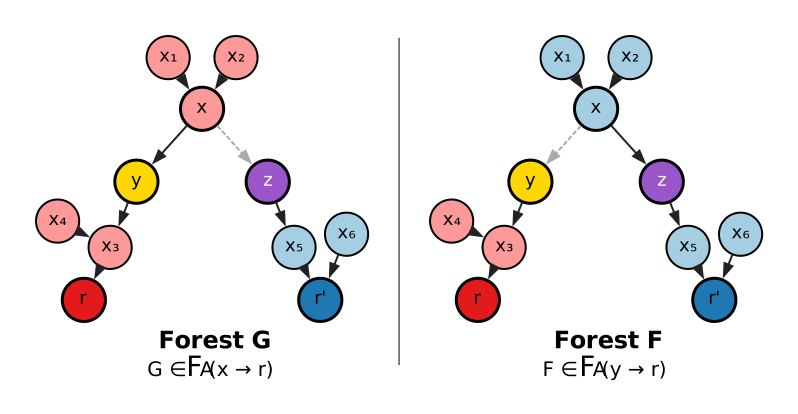
Exercise 3 Consider an irreducible Markov Chain on a finite state space \(S\) with transition probabilities \((p_{x,y})\). Recall that we consider \(S\) as a graph where the edges are the \(e=(x,y)\) such that \(p_{x,y}>0\). The weight of a rooted spanning in-forest \(F\) is the product \[ w(F):= \prod_{e\in F} p_e \] For \(A\subset S\) nonempty, let \(\mathfrak{F}_A\) be the set of rooted spanning in-forests, whose set of roots is exactly \(A\). For \(x\in S\) and \(r \in A\), define \(\mathfrak{F}_A(x\rightarrow r)\) as the set of forests \(F\in \mathfrak{F}_A\) such that \(x\) is in an in-arborescence rooted at \(r\) (in other words, following the unique path in \(F\) outgoing from \(x\), one reaches \(r \in A\)).
Let now \(r\in A \subset S\). Since the chain is irreducible and finite, \(\mathbb{P}(\tau_A<\infty)=1\), and let \(h(x)\equiv h_{r,A}(x):=\mathbb{P}_x(X_{\tau_A}=r)\). Prove that \[ h(x) = \frac{\sum_{F \in \mathfrak{F}_{A}(x\rightarrow r)} w(F)}{\sum_{F \in \mathfrak{F}_{A}} w(F)} \tag{1}\]
Since the Markov Chain is irreducible and has an invariant measure (being the state finite), \(h\) is the unique solution to the problem for the unknown \(u\) \[ (I-\ind{A^c} P)u= \ind{r} \] Let \(g(x)\) be the right hand side of Equation 1, we show that \(g\) also shows this equation, so \(g=h\).
Clearly \(g(x)=\ind{r}(x)\) for \(x\in A\), so we only need to check that \(g(x)=(Pg)(x)\) for \(x\notin A\). The denominator \(\sum_{F \in \mathfrak{F}_{A}} w(F)\) simplifies on both sides of this equation so it remains to verify \[ \sum_{G \in \mathfrak{F}_{A}(x\rightarrow r)} w(G) =^? \sum_y p_{x,y} \sum_{F \in \mathfrak{F}_{A}(y\rightarrow r)} w(F), \qquad x\notin A \] Since \(\sum_{y}p_{x,y}=1\) can we write this as \[ \sum_{z\neq x} \sum_{G \in \mathfrak{F}_{A}(x\rightarrow r)} p_{x,z} w(G) =^? \sum_{y\neq x} \sum_{F \in \mathfrak{F}_{A}(y\rightarrow r)} p_{x,y} w(F), \qquad x\notin A \] We can match terms on both sides, building a bijection between indices \((z,G)\) (with \(x\rightarrow r\) in \(G\)) on the left and \((y,F)\) (with \(y\rightarrow r\) in \(F\)) on the right as follows.
- If \(z\rightarrow r\) in \(G\), then we take \(y=z\) and \(G=F\), in other words these terms are on both sides.
- If \(z\not \rightarrow r\), then \((x,z)\) is not in \(G\). We match such a \((z,G)\) with the element \((y,F)\) in the r.h.s., where \(y\) is the unique vertex such that \((x,y)\in G\); and \(F\) is the forest obtained from \(G\) removing \((x,y)\) and adding \((x,z)\).
This is a bijection between summands in the l.h.s. and r.h.s. and clearly \(p_{x,z} w(G)= p_{x,y} w(F)\).